

Most carbon calculators can multiply two numbers.
If your company used 10,000 litres of diesel and the relevant emission factor is 2.5 kg CO₂e per litre, the arithmetic is easy.
The difficult questions come earlier.
Should the fuel be included? Which company or site does it belong to? Is the data complete? Which emission factor applies? Does that factor represent CO₂ or CO₂e? Is it suitable for the country and reporting year?
A credible company carbon footprint calculation depends far more on answering those questions correctly than on the multiplication itself.
Start With the Boundary
Before calculating emissions, the company needs an inventory boundary.
Which legal entities, sites and activities are included? Which emissions fall under Scope 1, Scope 2 or Scope 3? What reporting period does the calculation cover?
These decisions matter because flawless arithmetic cannot compensate for an incomplete inventory.
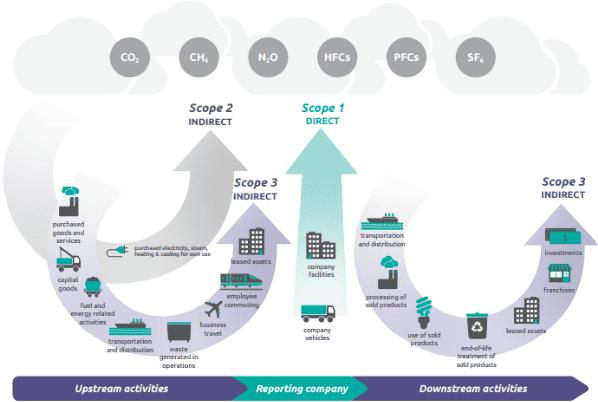
If an important site, vehicle fleet or activity has been left outside the boundary, the final number may still be wrong.
So the calculation begins by establishing exactly what the number is supposed to represent.
Company Data is Rarely Ready to Calculate
Once the boundary is clear, the activity data can be assembled: fuel consumption, electricity use, heating, travel, purchased materials, transport or other relevant information.
In practice, that information seldom arrives in one clean dataset.
An electricity invoice may cover the wrong period. A fuel report may include vehicles outside the reporting boundary. Heating may be included in rent. One site may provide actual consumption while another has only an estimate.
The useful question is therefore not simply whether a number exists, but what that number represents and whether it can reasonably be used.
Sometimes an estimate is necessary. That is not automatically a weakness. What matters is that the estimate is visible and its basis is documented.
A complete-looking spreadsheet is not the same thing as complete evidence.
Choosing the Emission Factor Is Part of the Work
The basic formula is simple:
Activity data × emission factor = emissions
Selecting the factor can be considerably less simple.
Several apparently plausible emission factors may exist for the same activity. They can differ by geography, year, technology, unit and methodological boundary.
Electricity provides a useful example.
Under the GHG Protocol, Scope 2 emissions may need to be calculated using both location-based and market-based methods.
The location-based result reflects the average emissions of the electricity grid. The market-based result reflects the electricity the company has purchased, where suitable supplier-specific or other qualifying information is available.
The same electricity consumption can therefore produce two legitimate results because the two methods answer different questions.
A figure such as:
Electricity emissions: 4.2 tCO₂e may consequently tell the reader too little.
Which method produced it? Which factor was used? Where did the factor come from?
A credible calculation should make those questions answerable.
Scope 3 Requires Judgement
Scope 3 contains 15 categories covering indirect emissions across the value chain.
Their relevance varies greatly from one company to another, and so does the quality of the available data.
The sensible starting point is to screen the categories, identify which could be material and then determine what data and calculation method are appropriate.
For one company, purchased materials may dominate the footprint. For another, transport or the use of sold products may matter far more.
Understanding the business therefore comes before deciding where Scope 3 calculation effort should go.
Can You Explain the Result?
There is a useful test for any corporate GHG inventory:
Can you explain how you arrived at the number?
If the company reports 486 tCO₂e, the material parts of that figure should be traceable back to the underlying data, emission factors, calculation methods and assumptions.
The calculation should leave enough of an audit trail for you to understand and explain the result without becoming a carbon-accounting specialist. This matters when a customer, funder, partner, or auditor asks:
How did you get this number?
“The calculator gave us the answer” is not a particularly strong response.
How Rodinia Approaches the Calculation
Rodinia takes responsibility for the technical carbon-accounting work rather than expecting the client to assemble the methodology themselves.
For Scope 3, we screen all 15 categories, determine which are relevant and select an appropriate calculation method for each material part of the value chain. Every category then receives a defined status – Reported, not applicable, Excluded or Unresolved – together with the reason for that status, so categories that are not calculated do not simply disappear from the inventory.
The calculation itself is built to preserve the basis of the result. Emission factors are recorded with their source, year, geography, unit and methodological boundary. The GWP set used for the inventory is stated explicitly, and location-based and market-based Scope 2 results are kept separate.
The calculation model also acts as the source of truth for the client deliverables. If a result changes during review, it is corrected in the calculation first and then carried through to the GHG Emissions Inventory, Calculation Methodology Report and Results Appendix.
We establish the inventory boundary, review and reconcile the source data, investigate gaps, research the relevant emission factors, perform the calculations and record material assumptions and estimates.
The client provides the business information and helps resolve questions that require company-specific knowledge. Rodinia turns that information into the calculation and supporting client deliverables.
The Number Comes Last
A company carbon footprint may eventually be summarised in one figure.
Its credibility depends on everything behind it: what was included, what data was used, which factors were selected, where estimates were necessary and how those decisions were documented.
The multiplication is the easy part. Knowing what belongs in the calculation (and being able to explain the result afterwards) is the real work.
Rodinia provides GHG Protocol-aligned company carbon footprint calculations covering Scope 1 and Scope 2, as well as Scope 3 where required.
If you need an emissions calculation for a customer request, tender, reporting requirement or your own sustainability work, book a 30-minute meeting with us. We can together determine what the calculation should cover and what information we would need from you.
